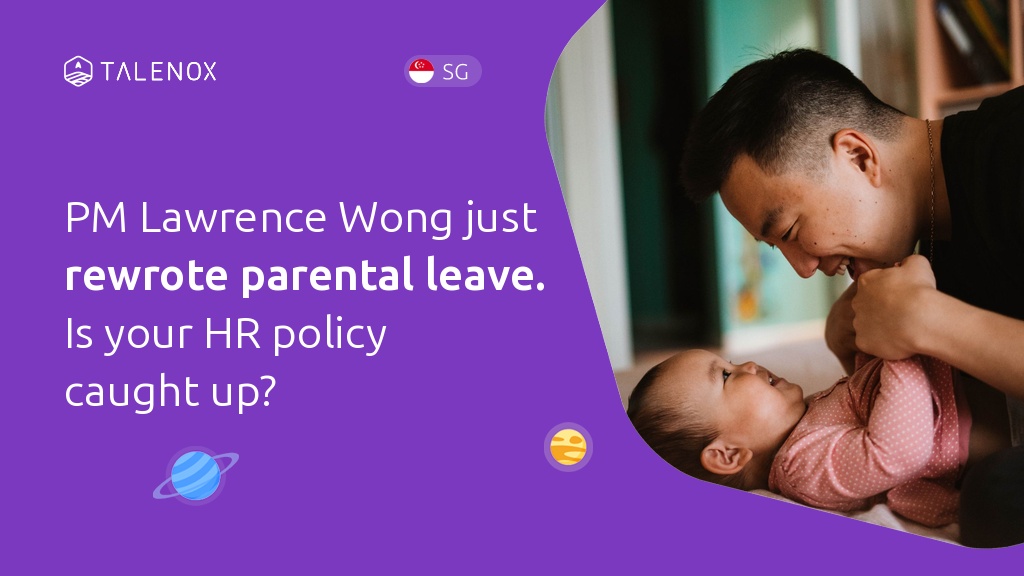
Singapore’s New Family Support Push: What It Means Beyond the Paycheck
September 04, 2026 · 5 min read
Dear employers: if you skimmed the headlines after this year’s National Day Rally and clocked it as “government gives parents more money,” you only got half the story.
PM Lawrence Wong stood up on 23 August and talked about walking alongside families through the whole journey of raising a child. Not a cheque at birth and a pat on the back. It’s a different posture entirely. So this is worth taking note of.
Here’s what changed, and why the details really matter to HR teams.
What Changed
The most concrete update from the Rally is childcare leave, and it’s tied to something new: how many kids you have.
Every working parent with a child aged 12 or under now gets eight days of childcare leave.
Parents with two children get 10. Three or more, and it’s 12 days, to be split across all their kids. That’s a real jump from the old system, where you got six days if your youngest was six or below, and just two days if your youngest was between seven and 12.
Run the numbers on a working couple with three primary school kids, and their combined childcare leave goes from four days today to 24.
There’s a second detail that’s easy to miss if you only read the leave numbers: the government is now fully funding statutory child-related leave. Previously, some of that cost sat with employers. The good news is that it doesn’t anymore (at least not for the statutory portion).
You might want to know that it’s worth checking your payroll setup against this rather than assuming it’s business as usual.
Then there’s the cash side, which is what actually made headlines. The new package works out to roughly $55,000 per baby over time – starting with a $7,000 payment at birth, followed by annual payments and credits that continue until the child turns 16. Budget 2026 had already laid some groundwork here too, with $500 in Child LifeSG Credits for every Singaporean child aged 12 and below.
None of this exists in isolation either. It sits on top of the parental leave changes that came into effect earlier this year – mandatory four-week paternity leave plus the expanded 10-week Shared Parental Leave scheme, bringing total parental leave to 30 weeks from April 2026. Yay!
The Tone Shift Is the Real Story
Go back and look at how PM Wong framed all this, and a pattern shows up. He wasn’t talking about incentivising a decision. He was talking about supporting a journey.
At the press briefing after the Rally, he put it plainly: the older approach leaned on direct incentives for babies. This one is about creating a family-friendly environment instead. Getting married and having children, he said, are deeply personal choices (thank you, PM) – so the government’s job isn’t to change minds about those choices, it’s to help remove the friction around them so there’s more flexibility in deciding if a child should or should not be brought into this world.
By the way, this work isn’t finished either.
The Marriage and Parenthood Reset Workgroup, chaired by Minister Indranee Rajah, is still active, and PM Wong was upfront that more is coming.
If you’re an HR lead treating this Rally as a one-time policy update to file away, you’re probably going to be revisiting this blog again within the year (or two, or three). We really can’t forecast this, sorry!
Quick Recap: NDR 2026 Family Support, By the Numbers
If you just want the figures without wading back through the speech, here’s the short version.
How much childcare leave do parents get now? Eight days a year for one child aged 12 or under, 10 days for two children, and 12 days for three or more, split across all their kids. That replaces the old system of six days (youngest child six or below) or two days (youngest child seven to 12).
Who pays for the extra leave? The government does. It’s now fully funding statutory child-related leave, which is a shift from the previous setup where part of that cost sat with employers.
How much cash support does a new baby get? Roughly $55,000 over time. That starts with a $7,000 payment at birth, followed by annual payments and credits that continue until the child turns 16.
Did Budget 2026 add anything on top of that? Yes. Every Singaporean child aged 12 and under got $500 in Child LifeSG Credits, announced back in February, before the Rally’s announcements were even on the table.
What about parental leave overall? Total parental leave reached 30 weeks from April 2026, combining four weeks of mandatory paternity leave with the 10-week Shared Parental Leave scheme.
When was this announced, and is it final? PM Lawrence Wong announced it at the National Day Rally on 23 August 2026. However this isn’t the end point either. There are still further changes to be made. Subscribe to our newsletter if you want to get the latest updates.
Where Employers Actually Come In
This bit didn’t get nearly as much coverage as the leave numbers. NTUC and a few Labour MPs welcomed the expansion, but they also raised a concern that’s easy to gloss over: parents need to actually feel okay using this leave, instead of quietly worrying it’ll show up against them at review time.
That’s on us, not the government. You can put 12 days of childcare leave on paper and still watch nobody on your team touch more than three or four of them, because everyone’s absorbed the same unspoken rule – the people who want to move up don’t take the full amount. Raise the entitlement all you want. If that culture is sitting underneath it, nothing actually changes for your parents.
So here’s our Talenox Tip –
Go back through your leave policy and check it against the new numbers. A lot of internal childcare leave provisions are still built around the old six-day, two-day split, and your payroll system needs to reflect that the government’s now covering the statutory portion.
Get ahead of your managers on this. If someone on a team is suddenly entitled to 24 combined days instead of four, their manager should already know that’s the new normal before the request lands on their desk, not find out from HR after the fact. If possible, conduct a briefing for all managers or make sure your leave system has some notification on updates like these.
None of this means overhauling your HR playbook. It just means not treating the Rally as a headline that comes and goes. The government has taken care of the cost side. What happens when a parent on your team actually puts their hand up and asks to use this stuff – that part’s still down to you.
Getting the numbers right in your own systems is the easy part to fix, at least. Talenox’s Leave module already comes with Singapore’s statutory leave types built in, so when MOM updates the childcare leave quantum or the funding structure changes, your entitlements update with it instead of sitting on a spreadsheet someone forgot to touch since last year. Yes, you can finally set your mind at ease.



 Singapore
 Hong Kong
 Malaysia
 Global